
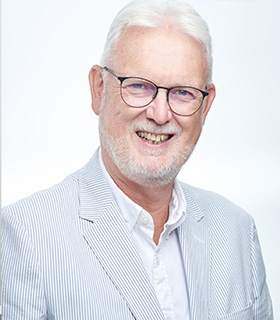
David is an experienced senior executive and finance professional, having previously been Chief Executive and Finance Director at The Hyde Group, a large South East London-based housing association, and Chief Operating Officer at Leonard Cheshire Disability, a major provider of services to disabled people. He is now semi-retired and operates a small portfolio of non-executive director appointments. He also undertakes project work as a Consultant Director in the Affordable Housing Consultancy Team at Savills, where he specialises in the strategic business development and corporate financial management of housing associations.
David has a degree in Mathematics and Education from the University of Kent, is a Fellow of the Chartered Institute of Management Accountants, and a Corporate Member of the Chartered Institute of Housing. He was previously the Chair of London Skills for Growth and led the charity through the merger with London South East Colleges in 2017. He was appointed to the Chair of the London South East Colleges Corporation in January 2022.
National Volunteer Week: Q&A with David Eastgate - Chair of London South East Colleges
In this conversation, David Eastgate reflects on the value of volunteering, the importance of strong leadership and governance, and the role colleges play in creating lasting impact across their communities.
-
During National Volunteer Week, why does volunteering matter so much to London South East Colleges and the communities it serves?
For me it is really about using experience, judgement and professional skills in service of something that matters. Chairing a college board carries real responsibility. It is strategic, demanding and ultimately focused on doing the right thing for learners and for the wider community.
That is why volunteering in this context is so powerful. It is not simply about giving time; it is about helping shape institutions that can transform lives. Colleges exist for learners, and when governors and board members give their time well, they can help create better opportunities, stronger communities and lasting change.
-
What makes this role so rewarding and how does strong governance create lasting change for students, staff and the wider community?
It is rewarding because it is stimulating, challenging and meaningful. I enjoy being able to bring together years of experience and apply that in a way that feels relevant and useful. The role keeps me thinking, keeps me engaged and gives me the chance to contribute to something bigger than myself.
I also find real value in building and shaping an effective board. A strong board should reflect the community it serves, bring a wide range of skills and perspectives, and create the conditions for good decisions. Diversity is essential in that. It is about lived experience and proximity to the realities our learners face. If we want to understand the lives, pressures and ambitions of young people today, we need people around the table who are closer to those experiences.
A representative board is a stronger board. It helps us make better decisions, stay connected to our communities and remain focused on what learners actually need, rather than what we assume they need. That is part of what makes the role so worthwhile.
-
Is there a moment or achievement that stands out as a lasting example of the board's impact?
One of the clearest examples is the transformation of the Plumstead campus. Seeing what it was and what it has become is remarkable. Projects like that take hard work, scrutiny, resilience and a willingness to bring different expertise together around the table, but the outcome can be genuinely transformative.
What matters most is that everyone is pulling in the same direction. Good governance means supporting the executive well, asking the right questions and keeping sight of the outcome you want for learners. When that happens, the results are tangible: better spaces, better facilities, better technology and a better overall experience for students and staff.
-
How do you see the role of chair in strengthening a college's impact across its community?
For me, it starts with getting the right people around the table: people with strong skills, local knowledge, community links and the ability to contribute in different ways. A chair is not there to do everything personally. The real job is to create the conditions in which other people can bring their expertise to the fore.
I often think of chairing as being a bit like conducting an orchestra. You bring together talented people, help set direction, make sure everyone is working in tune and at the right pace, and create a platform for others to perform at their best. Done well, that strengthens the college’s connection to employers, communities and learners alike.
-
Finally, what message would you share during National Volunteers Week with those who already volunteer and those considering it?
First of all, a huge thank you to everyone who already gives their time. Volunteering matters, and it does make a difference. It can be demanding, and there is real commitment and responsibility attached to it, but it is also deeply rewarding.
My message would be simple: if you commit to it properly, give your time willingly and bring your experience fully, you will get so much out of it. Volunteering is one of the clearest ways to contribute to positive change, and the impact can reach far beyond what you first expect.
This conversation highlights that volunteering in education is not only about giving time, but about bringing experience, leadership and perspective to create lasting opportunities for learners. Strong governance, diverse voices and a shared sense of purpose all play a vital role in building colleges that serve their communities well.
